Atomized spherical Mg-Al alloy powder
Atomized spherical Mg-Al alloy powder
| Atomized spherical Mg-Al alloy powder | |
| Product No | NRE-60103 |
| Purity | 99.9% |
| Mesh | 30-500 mesh |
| Color | Silver Gray |
| Shape | spherical | |
| The proportion of Sphere /% | ≥95 | |
| Apparent density /g·cm-3 | 1.236 | |
| Real density /g·cm-3 | 2.1153 | |
| Fluidity /s·(50g)-1 | 53 | |
| Moisture absorption rate /% | 0.01 | |
| Active Mg+Al content /% | 99.25 | |
| Calorific value kJ/g | 23.26 | |
|
Impurity
content
/% |
Moisture/%(max) | 0.05 |
| Insoluble material in HCl /%(max) | 0.13 | |
| Oil & grease /%(max) | 0.00 | |
| Fe/%(max) | 0.05 | |
| Mn/%(max) | 0.01 | |
| Zn/%(max) | 0.01 | |
| Cl/%(max) | 0.003 | |
Atomized spherical Mg-Al alloy powder
Introduction
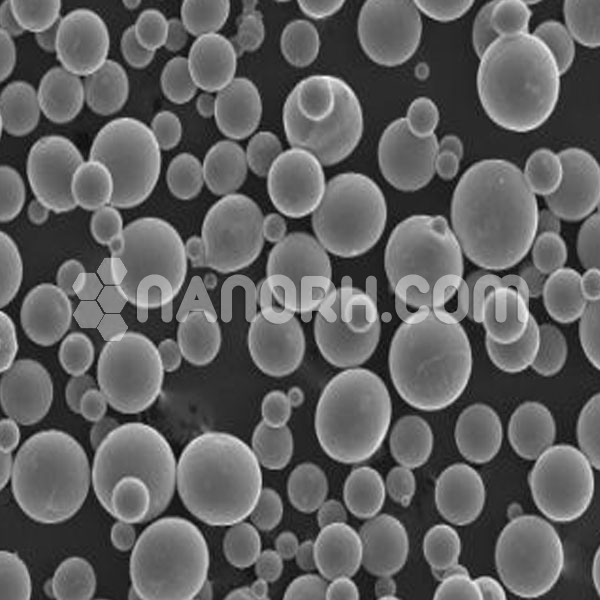
Atomized spherical Mg-Al (Magnesium-Aluminum) alloy powders are produced by atomizing a molten blend of magnesium and aluminum. The atomization process (usually gas or water atomization) creates fine, spherical particles with a uniform distribution of alloying elements.
Key Features
Spherical Shape:
The spherical shape improves powder flowability, enabling uniform spreading and better packing density in additive manufacturing and other powder-based processes.
Low Density:
Magnesium alloys, in general, are known for their low density, making them ideal for applications where reducing weight is a priority, such as in aerospace and automotive industries.
High Strength-to-Weight Ratio:
Mg-Al alloys offer a high specific strength (strength per unit weight), making them suitable for structural applications where minimizing weight without compromising strength is critical.
Good Corrosion Resistance:
The addition of aluminum to magnesium enhances the material’s corrosion resistance, especially in atmospheric and marine environments, expanding its potential applications.
Improved Processability:
Spherical powders are easy to handle and provide better flowability, making them suitable for powder metallurgy (PM), additive manufacturing, and thermal spraying.
Thermal Conductivity and Damping Properties:
Magnesium alloys generally have high thermal conductivity and good damping properties, making them ideal for applications in thermal management and vibration damping.
Low Thermal Expansion:
Magnesium alloys exhibit low thermal expansion, making them suitable for high-precision applications where dimensional stability under temperature changes is essential.