
Metal Spherical Powder
Metal Spherical Powder
Introduction
Metal spherical powders have emerged as a critical material in modern manufacturing and advanced engineering applications. Unlike irregular or flake-shaped powders, spherical powders possess a uniform shape that offers superior flowability, packing density, and performance. These powders are widely used in industries such as additive manufacturing (3D printing), powder metallurgy, coatings, and thermal spraying.
With the rapid advancement of technologies like aerospace engineering, biomedical implants, and high-performance electronics, the demand for high-quality spherical metal powders is increasing significantly. This blog explores the characteristics, production methods, advantages, and applications of metal spherical powders.
What is Metal Spherical Powder?
Metal spherical powder refers to finely divided metal particles that have a near-perfect spherical shape. These powders can be made from various metals and alloys, including:
- Aluminum
- Copper
- Iron
- Nickel
- Titanium
- Stainless steel
- Cobalt alloys
The spherical shape minimizes friction between particles, allowing them to flow easily and pack efficiently. This makes them ideal for processes that require precision and consistency.
Key Properties of Metal Spherical Powder
- Excellent Flowability
Spherical particles roll easily over one another, providing excellent flow characteristics. This is especially important in applications like 3D printing, where uniform layer deposition is required.
- High Packing Density
Due to their uniform shape, spherical powders can pack closely together, reducing void spaces and improving the density of the final product.
- Uniform Particle Size Distribution
Controlled production processes ensure consistent particle size, which enhances performance in precision applications.
- Reduced Oxidation
Many spherical powders are produced in controlled environments, minimizing oxidation and improving material purity.
- Smoother Surface Finish
Components manufactured using spherical powders often exhibit smoother surfaces compared to those made with irregular powders.
Production Methods of Metal Spherical Powder
Several advanced techniques are used to produce spherical metal powders. The choice of method depends on the material, required purity, and application.
-
Gas Atomization
Gas atomization is the most widely used method for producing spherical powders.
Process:
- Molten metal is poured through a nozzle.
- High-pressure inert gas (such as argon or nitrogen) breaks the molten stream into fine droplets.
- These droplets solidify into spherical particles.
Advantages:
- High purity
- Controlled particle size
- Excellent sphericity
-
Plasma Atomization
Plasma atomization is used for high-performance materials like titanium.
Process:
- Metal wire is fed into a plasma torch.
- The intense heat melts the metal.
- The molten droplets form spherical particles upon cooling.
Advantages:
- Ultra-High Purity
- Perfect spherical morphology
- Ideal for medical and aerospace use
-
Water Atomization (Modified)
Although traditional water atomization produces irregular powders, modified techniques can produce semi-spherical particles.
Advantages:
- Cost-effective
- Suitable for bulk applications
-
Plasma Rotating Electrode Process (PREP)
Process:
- A rotating metal rod is melted at one end using plasma.
- Centrifugal force throws off molten droplets.
- These droplets solidify into spherical powders.
Advantages:
- Very clean process
- Minimal contamination
- Narrow particle size distribution
Advantages of Metal Spherical Powder
- Improved Process Efficiency
Spherical powders flow easily, reducing clogging and improving manufacturing speed.
- Better Mechanical Properties
Parts made from spherical powders often exhibit higher strength and durability.
- Reduced Material Waste
Efficient packing and uniformity reduce material wastage during processing.
- Enhanced Printing Performance
In additive manufacturing, spherical powders ensure smooth layer formation and consistent results.
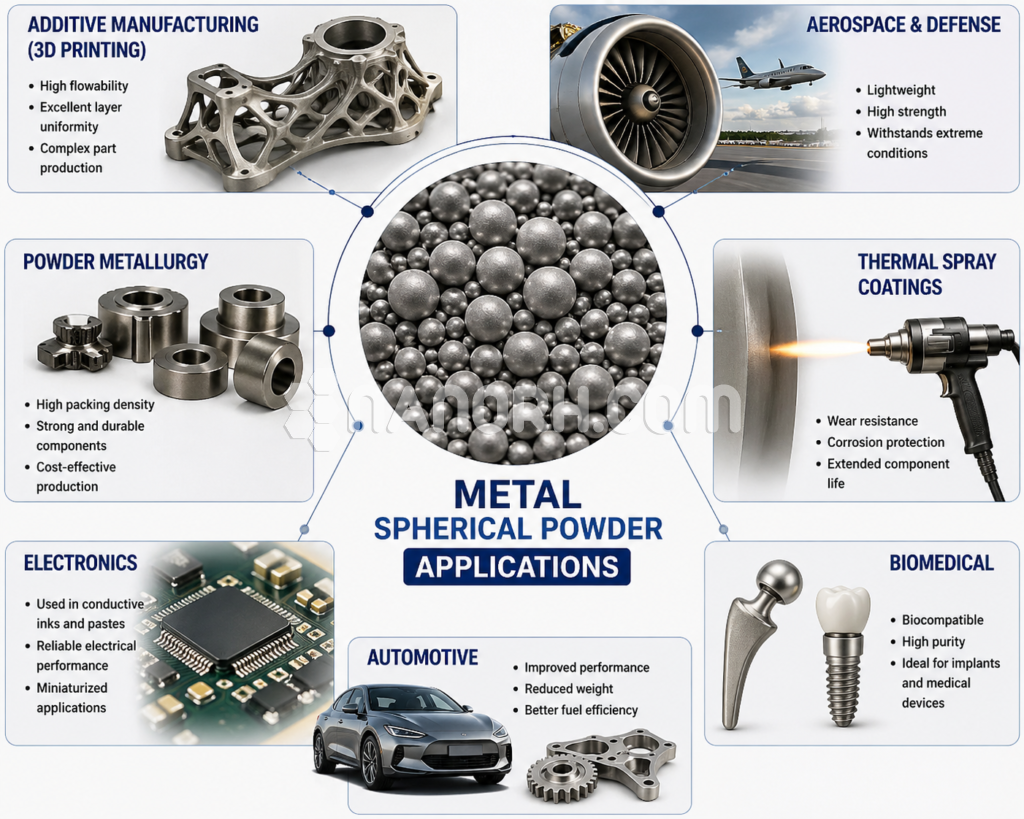
Applications of Metal Spherical Powder
-
Additive Manufacturing (3D Printing)
This is one of the fastest-growing applications.
Uses:
- Aerospace components
- Medical implants
- Automotive parts
Spherical powders ensure precise layering, high density, and excellent mechanical properties.
-
Powder Metallurgy
Used in the production of complex metal components by compacting and sintering powders.
Applications:
- Gears
- Bearings
- Structural components
-
Thermal Spray Coatings
Spherical powders are used to create protective coatings on surfaces.
Benefits:
- Corrosion resistance
- Wear resistance
- Thermal insulation
-
Electronics and Conductive Materials
Fine spherical powders are used in conductive inks and pastes.
Applications:
- Printed electronics
- Circuit boards
- Sensors
-
Aerospace and Defense
High-performance alloys in spherical form are used in critical components.
Advantages:
- Lightweight
- High strength
- Resistance to extreme temperatures
-
Biomedical Applications
Spherical powders like titanium are widely used in medical implants.
Examples:
- Hip implants
- Dental implants
Their biocompatibility and strength make them ideal for such applications.
Challenges in Metal Spherical Powder Production
Despite their advantages, there are some challenges:
- High Production Cost
Advanced methods like plasma atomization are expensive.
- Equipment Complexity
Specialized equipment and controlled environments are required.
- Limited Availability for Some Metals
Not all metals can be easily converted into spherical powders.
Future Trends
The future of metal spherical powder is closely linked with advancements in manufacturing technologies.
- Growth of Additive Manufacturing
As 3D printing becomes more mainstream, demand for spherical powders will increase.
- Development of New Alloys
Research is ongoing to develop powders with enhanced properties.
- Sustainable Production Methods
Efforts are being made to reduce energy consumption and improve recyclability.
Conclusion
Metal spherical powders are revolutionizing modern manufacturing by offering superior performance, precision, and efficiency. Their unique properties make them indispensable in industries ranging from aerospace to healthcare.
With continuous advancements in production technologies and increasing demand for high-performance materials, metal spherical powders are set to play a crucial role in shaping the future of manufacturing.
