
Chitosan Nanoparticles
Chitosan Nanoparticles
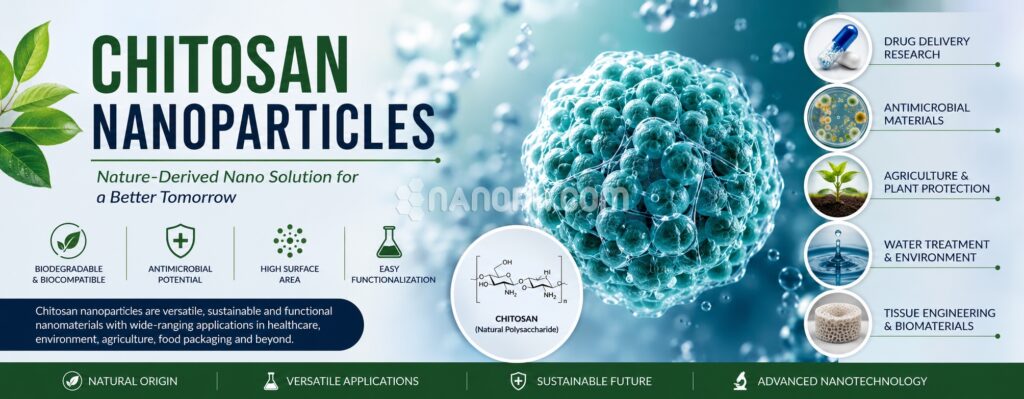
Chitosan nanoparticles are nanoscale materials derived from chitosan, a natural polysaccharide obtained primarily through the deacetylation of chitin. Chitin is one of the most abundant natural polymers and is found in sources such as shrimp, crab shells, insect exoskeletons, and fungal cell walls. Because chitosan is biodegradable, biocompatible, renewable, and chemically versatile, its nanoscale form has attracted significant attention in materials science, biotechnology, environmental engineering, agriculture, and pharmaceutical research.
Typically ranging from several nanometers to a few hundred nanometers in size, chitosan nanoparticles exhibit properties that can differ significantly from bulk chitosan. Their high surface-area-to-volume ratio, surface charge, functional groups, and tunable morphology make them useful for applications where controlled interaction with other materials or biological systems is required.
What Are Chitosan Nanoparticles?
Chitosan nanoparticles are particulate structures formed by converting chitosan polymer chains into nanoscale particles. Chitosan contains reactive amino (-NH₂) and hydroxyl (-OH) groups, which provide sites for chemical modification and interaction with other molecules.
One of the most important characteristics of chitosan is its pH-dependent charge. Under acidic conditions, the amino groups can become protonated, giving chitosan a positive surface charge. This characteristic allows chitosan nanoparticles to interact electrostatically with negatively charged molecules, surfaces, and biological membranes.
The properties of the nanoparticles depend on several factors, including molecular weight, degree of deacetylation, particle size, preparation method, crosslinking agent, pH, and concentration of the starting materials.
Key Properties of Chitosan Nanoparticles
Chitosan nanoparticles possess a combination of physicochemical properties that make them attractive for advanced material applications.
Biodegradability: Chitosan can naturally degrade under suitable conditions, making it an attractive alternative to some persistent synthetic polymers.
Biocompatibility: Properly prepared chitosan-based materials are widely investigated for interactions with biological systems.
Surface functionality: The amino and hydroxyl groups provide opportunities for functionalization and attachment of other molecules.
Positive surface charge: Depending on environmental conditions, protonated amino groups can give chitosan nanoparticles a positive surface charge.
High surface area: Nanoscale dimensions provide a large surface area relative to particle volume, which can improve adsorption and interaction with surrounding materials.
Antimicrobial potential: Chitosan and its nanoscale derivatives have been extensively investigated for antimicrobial activity, although performance depends strongly on particle characteristics and experimental conditions.
Chemical versatility: Chitosan nanoparticles can be modified with polymers, inorganic nanoparticles, biomolecules, and other functional compounds to create specialized nanocomposites.
Methods of Synthesis
Several approaches can be used to prepare chitosan nanoparticles. The choice of method depends on the desired particle size, morphology, surface characteristics, loading capacity, and intended application.
Ionic Gelation
Ionic gelation is one of the most commonly investigated approaches. In this method, positively charged chitosan interacts with a negatively charged crosslinking agent, commonly a polyanion such as tripolyphosphate. The electrostatic interaction causes the polymer chains to form nanoscale structures.
The process can be relatively simple and can often be performed under mild conditions. Parameters such as chitosan concentration, crosslinker concentration, pH, mixing rate, and addition rate can significantly influence the resulting particle size and distribution.
Emulsion-Based Methods
Emulsion techniques involve dispersing a chitosan-containing phase within another immiscible phase, followed by stabilization and crosslinking. These methods can provide control over particle characteristics but may require additional processing and removal of solvents or surfactants.
Covalent Crosslinking
Chemical crosslinking can be used to improve the stability of chitosan nanoparticles. A suitable crosslinking chemistry creates stronger interactions between polymer chains. However, the choice of crosslinker is important, particularly when the nanoparticles are intended for biological or environmentally sensitive applications.
Nanoprecipitation and Other Advanced Methods
Other approaches include precipitation, spray drying, reverse micelle methods, and combinations of physical and chemical techniques. Modern research increasingly focuses on scalable and reproducible preparation methods capable of producing nanoparticles with narrow particle-size distributions.
Characterization of Chitosan Nanoparticles
Characterization is essential for determining whether the prepared nanoparticles meet the required specifications.
Particle size and size distribution: Dynamic light scattering (DLS) is commonly used for measuring hydrodynamic particle size and polydispersity.
Zeta potential: Zeta-potential measurements provide information about surface charge and can help evaluate colloidal stability.
Transmission Electron Microscopy (TEM): TEM can provide information about nanoparticle morphology and approximate physical dimensions.
Scanning Electron Microscopy (SEM): SEM can be used to examine surface morphology and particle structure.
Fourier Transform Infrared Spectroscopy (FTIR): FTIR is useful for identifying characteristic functional groups and investigating interactions or chemical modifications.
X-ray Diffraction (XRD): XRD can help evaluate the crystalline or semi-crystalline structure of chitosan-based materials.
Thermal analysis: Techniques such as TGA and DSC can provide information about thermal stability and transitions.
These characterization techniques are often combined to obtain a comprehensive understanding of nanoparticle properties.
Applications of Chitosan Nanoparticles
Chitosan nanoparticles have attracted interest across numerous research and industrial fields.
Drug and Bioactive Delivery Research
Their surface chemistry and ability to interact with biological molecules make chitosan nanoparticles interesting candidates for controlled delivery research. Researchers investigate their potential to encapsulate or associate with various active compounds and modify their release behavior.
Antimicrobial Materials
Chitosan nanoparticles are being studied for antimicrobial coatings, packaging research, surface treatments, and other applications where interaction with microorganisms is important. Their activity can depend on particle size, molecular weight, degree of deacetylation, surface charge, and concentration.
Food Packaging Research
Because chitosan is a natural polymer and can form films and coatings, chitosan nanoparticles are being investigated as components of advanced packaging materials. Incorporating nanoparticles into polymer matrices may help modify barrier, mechanical, and functional properties.
Agriculture
Chitosan-based nanomaterials are being researched for agricultural applications, including plant protection, nutrient delivery, seed treatment, and controlled release systems. Their biodegradability and functional surface chemistry make them particularly interesting for developing next-generation agricultural materials.
Water and Environmental Applications
The amino and hydroxyl groups of chitosan can interact with various contaminants. Consequently, chitosan nanoparticles and chitosan-based nanocomposites are being investigated as adsorbents for dyes, metal ions, and other pollutants in water-treatment research.
Tissue Engineering and Biomaterials
Chitosan nanoparticles are also investigated in biomaterials and tissue-engineering research. They can be incorporated into scaffolds, hydrogels, coatings, and composite systems to modify mechanical, surface, and biological characteristics.
Advantages and Challenges
The major advantages of chitosan nanoparticles include their renewable origin, biodegradability, functional surface groups, tunable physicochemical properties, and relatively flexible processing options.
However, several challenges remain. Particle aggregation can occur because of interactions between nanoparticles. Batch-to-batch variation in chitosan properties can also affect reproducibility. Parameters such as molecular weight and degree of deacetylation need to be carefully controlled. In addition, scaling laboratory synthesis to industrial production while maintaining consistent particle size and surface properties can be challenging.
For commercial and research applications, proper characterization and quality control are therefore essential.
Future Prospects
The future development of chitosan nanoparticles is expected to focus on improved control over particle size, surface functionality, stability, and production scalability. Researchers are also exploring hybrid materials combining chitosan nanoparticles with metals, metal oxides, silica, bioactive glasses, carbon-based nanomaterials, and other polymers.
Advanced surface functionalization could enable the development of application-specific nanoparticles with improved adsorption, catalytic, antimicrobial, sensing, or delivery characteristics. Sustainable production methods and environmentally friendly processing are also becoming increasingly important as interest in bio-based nanomaterials continues to grow.
Conclusion
Chitosan nanoparticles represent an important class of bio-based nanomaterials with considerable potential across materials science, environmental research, agriculture, biotechnology, and other advanced research fields. Their nanoscale dimensions, functional amino and hydroxyl groups, surface-charge characteristics, biodegradability, and chemical versatility provide a strong foundation for developing customized nanomaterials.
Continued research into synthesis, characterization, surface modification, stability, and scalable manufacturing will help expand the practical use of chitosan nanoparticles. As demand increases for sustainable and multifunctional nanomaterials, chitosan nanoparticles are likely to remain an important area of research and development.
