
What is Atomized Spherical Powder?
Atomized Spherical Powder
Atomized spherical powder is an advanced material form widely used in modern manufacturing industries due to its unique structure and performance advantages. Unlike conventional powders that have irregular or angular shapes, atomized spherical powders consist of smooth, round particles that significantly enhance processing efficiency and final product quality.
With the rapid growth of technologies such as additive manufacturing (3D printing), powder metallurgy, and thermal spraying, the demand for high-quality spherical powders has increased substantially. These powders are now considered essential in industries like aerospace, automotive, electronics, and biomedical engineering.
This blog provides a detailed overview of atomized spherical powder, including its definition, production methods, key properties, advantages, and industrial applications.
What is Atomized Spherical Powder?
Atomized spherical powder refers to finely divided particles of metals or alloys produced through atomization processes, where molten material is disintegrated into droplets and solidified into spherical shapes.
The defining characteristic of this powder is its spherical morphology, which offers superior flowability, uniform packing, and reduced friction compared to irregular powders. These powders are typically available in a wide particle size range, from a few microns to several hundred microns, depending on the application.
Common materials used for atomized spherical powders include:
- Aluminum and its alloys
- Copper
- Iron and steel
- Nickel-based alloys
- Titanium alloys
- Cobalt alloys
- Precious metals such as silver and gold
Production Methods of Atomized Spherical Powder
The production of spherical powder involves converting molten material into fine droplets that solidify rapidly. Several atomization techniques are used depending on the required quality and application.
Gas Atomization
Gas atomization is the most widely used technique for producing high-quality spherical powders. In this process, molten metal is poured through a nozzle and disintegrated using high-pressure inert gases such as argon or nitrogen.
This method produces powders with:
- Excellent sphericity
- Low oxygen content
- Controlled particle size distribution
Gas atomized powders are commonly used in high-performance applications such as aerospace and additive manufacturing.
Water Atomization
Water atomization uses high-pressure water jets to break molten metal into droplets. Although this method is more cost-effective, it typically produces irregular or semi-spherical particles.
Key characteristics include:
- Lower production cost
- Higher oxidation levels
- Less uniform particle shape
These powders are suitable for applications where perfect sphericity is not critical, such as basic powder metallurgy.
Plasma Atomization
Plasma atomization is an advanced technique used for producing ultra-pure and highly spherical powders. In this process, metal feedstock (often wire) is melted using a plasma torch and atomized into fine droplets.
Advantages include:
- Very high purity
- Excellent spherical shape
- Minimal contamination
This method is commonly used for titanium and other high-value materials in aerospace and medical applications.
Centrifugal Atomization
In centrifugal atomization, molten metal is rotated at high speed, and droplets are formed due to centrifugal forces.
This process offers:
- Narrow particle size distribution
- Good sphericity
- Efficient production
Key Properties of Atomized Spherical Powder
Atomized spherical powders possess several unique properties that make them superior to conventional powders:
High Flowability
The smooth and round shape of particles allows them to flow easily, which is essential in automated manufacturing processes like 3D printing and powder coating.
Uniform Particle Size Distribution
Controlled atomization ensures consistent particle sizes, leading to better process control and uniform product quality.
High Packing Density
Spherical particles pack closely together, reducing void spaces and improving the density and strength of final components.
Low Surface Area
Compared to irregular powders, spherical powders have a lower surface area, reducing oxidation and improving stability.
High Purity
Advanced atomization techniques, especially gas and plasma atomization, produce powders with minimal impurities and contamination.
Advantages of Atomized Spherical Powder
The use of atomized spherical powder offers several benefits across industries:
- Enhanced processing efficiency
- Improved surface finish of manufactured parts
- Reduced material waste
- Better mechanical properties
- Consistent and repeatable performance
- Improved sintering behavior
These advantages make spherical powders highly desirable for precision applications.
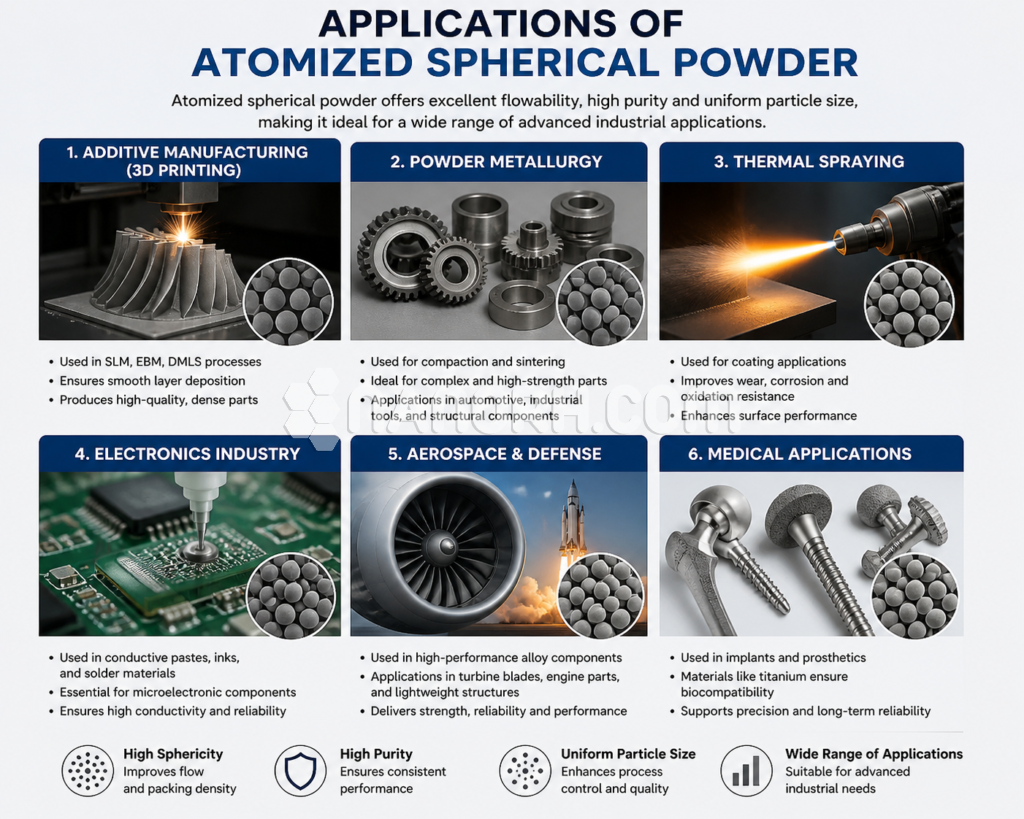
Applications of Atomized Spherical Powder
Additive Manufacturing (3D Printing)
Atomized spherical powders are extensively used in metal 3D printing technologies such as Selective Laser Melting (SLM) and Electron Beam Melting (EBM). Their excellent flowability ensures smooth layer deposition, while uniform particle size contributes to high-quality printed components.
Powder Metallurgy
In powder metallurgy, spherical powders are used for compaction and sintering processes to produce complex and high-strength components.
Typical applications include:
- Automotive gears and parts
- Bearings
- Structural components
Thermal Spraying
Spherical powders are used in thermal spray coatings to enhance surface properties such as:
- Wear resistance
- Corrosion resistance
- Thermal protection
Electronics Industry
Fine spherical powders are essential in electronics manufacturing, where they are used in:
- Conductive inks and pastes
- Solder materials
- Microelectronic components
Aerospace and Defense
High-performance spherical powders are used to manufacture lightweight and high-strength components for aerospace applications, including turbine blades, engine parts, and structural elements.
Medical Applications
In the biomedical field, spherical powders are used in implants and prosthetics. Materials like titanium are preferred due to their biocompatibility and corrosion resistance.
Factors to Consider When Selecting Atomized Powder
Choosing the right atomized spherical powder depends on several factors:
- Particle size and distribution
- Material composition
- Purity level
- Flow characteristics
- Application-specific requirements
Proper selection ensures optimal performance and cost efficiency.
Challenges in Production and Usage
Despite their advantages, atomized spherical powders come with certain challenges:
- High production cost, especially for gas and plasma atomization
- Requirement of controlled environments
- Sensitivity to contamination
- Storage and handling precautions to prevent oxidation
Future Trends and Market Growth
The demand for atomized spherical powder is rapidly increasing due to advancements in emerging technologies. Industries such as additive manufacturing, electric vehicles, and renewable energy are driving the need for high-performance materials.
Future developments are focused on:
- Nano-sized spherical powders
- Advanced alloy compositions
- Sustainable and cost-effective production methods
Conclusion
Atomized spherical powder is a crucial material in modern manufacturing, offering superior performance due to its unique structure and properties. Its high flowability, purity, and packing efficiency make it indispensable in industries ranging from aerospace to electronics and healthcare.
As technology continues to evolve, the importance of high-quality spherical powders will only grow, making them a key component in the future of advanced materials and engineering.
