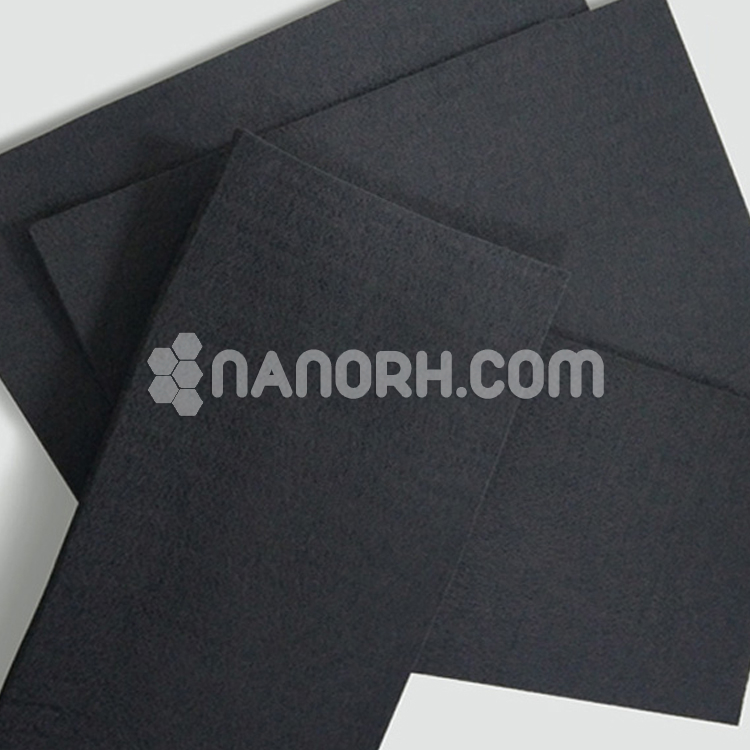
Carbon Felt Electrode
Carbon Felt Electrode
| Carbon Felt Electrode | |
| Product No | NRE-53004-1 |
| Carbon Content | ≥99 % |
| Bulk Density | 0.08-0.10 g/cm3 |
| Tensile Strength | ≥0.05 MPa |
| Electrical Resistance | <100 Ω.cm2 |
| Specific Surface Area | 1.0-4.0 g/m2 |
| Shedding Rate | <1 % |
| Thickness | 5.0 mm (±7.5%) |
| Porosity | ≥90 % |
Carbon Felt Electrode
Recommended Operating Conditions:
Operating Temperature: Room temperature (20-30°C)
Operating Environment: Installed in flow battery stack with appropriate conrate, used as dual electrode.
Storage Conditions & Service Life
Storage Condition: Store in a dry, dark and normal temprature environmentightly, avoid extrusion and collision.
Shelf Life: 2 years after production
Applications:
Carbon felt electrodes are widely used across advanced electrochemical and energy systems due to their high surface area, excellent electrical conductivity, chemical stability, and porous 3D structure. These properties make them ideal for reactions requiring efficient electron transfer and fluid flow.
One of the most prominent applications is in Redox Flow Batteries, where carbon felt acts as the electrode material facilitating redox reactions of electrolytes (such as vanadium ions). Its high porosity allows better electrolyte penetration, improving energy efficiency and cycle life.
In fuel cells, particularly in systems like Proton Exchange Membrane Fuel Cells, carbon felt is used as a gas diffusion layer or electrode support, helping distribute reactant gases and enhance electrochemical reactions.
Carbon felt electrodes are also essential in electrochemical wastewater treatment, where they support oxidation and reduction reactions to remove contaminants such as heavy metals, dyes, and organic pollutants. Their durability and resistance to corrosion make them suitable for harsh chemical environments.
Another important area is electrosynthesis and electroorganic chemistry, where carbon felt provides a large reactive surface for synthesizing fine chemicals, pharmaceuticals, and intermediates with high efficiency.
In metal recovery and electroplating, carbon felt electrodes help in the deposition and recovery of metals like copper, nickel, and gold from industrial waste streams due to their conductive and chemically inert nature.
Additionally, carbon felt is used in energy storage devices such as supercapacitors and hybrid systems, where it contributes to high charge storage capacity and rapid charge-discharge cycles.
Overall, carbon felt electrodes are critical in modern electrochemical technologies, enabling efficient, scalable, and sustainable industrial processes across energy, environmental, and chemical sectors.